

Standard tools work while a process can fit them. When permanent exceptions, duplicated data and manual controls become normal, maintaining that adaptation may cost more than designing the right system.
A sound decision begins with the goal and the real journey, not a feature list. When every component has a reason, the investment becomes easier to understand and sustain.
What to define before choosing a solution
Define what a person must be able to do, which information is required and who will manage the solution after launch. This supports the right scope without unnecessary complexity.
The best solution is not the one with the longest feature list, but the one that best supports the goal, operation and available capacity.
Growth should be considered without treating every future possibility as a current requirement. A strong foundation can evolve in stages.
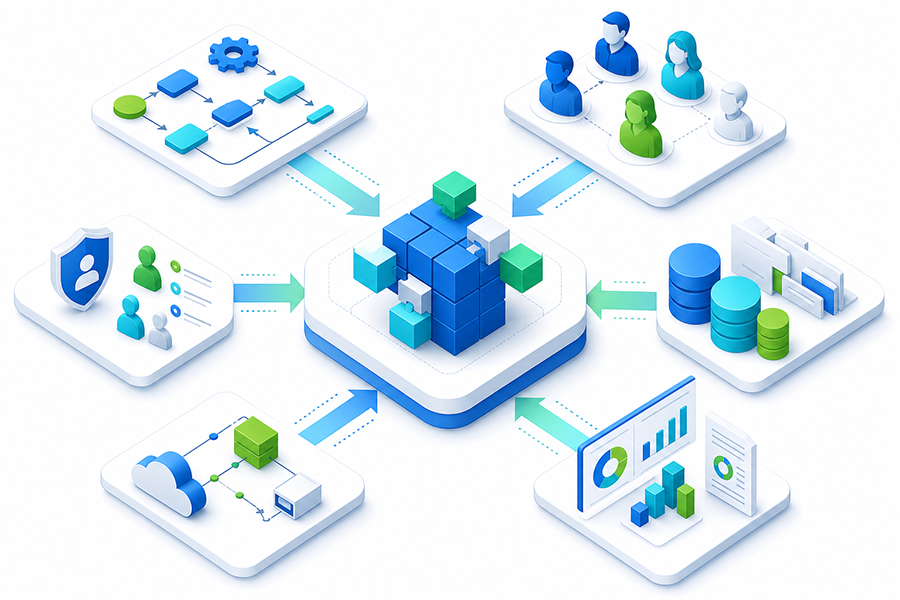
The components that must work together
Process and exceptions
Clarifies the expected outcome and whom it should help.
Users, data and permissions
Connects content, operation and ownership in one journey.
Integrations and tracking
Defines how results, problems and improvement opportunities will be observed.
A quick clarity test
Describe the complete journey aloud. Any step without ownership, information or criteria reveals an unresolved decision.
Questions for organizing the decision
- What is the primary goal? Choose one concrete action or improvement.
- Who will use it? Consider the audience, team and owners.
- What must be managed? Define what changes and who updates it.
- How will it be measured? Select a signal tied to the real outcome.
Process → Roles → Data → Rules → Integrations → Reports
A useful signal could be recorded as process_completed_without_rework.
A practical journey
- Diagnose. Review the goal, audience, information and current operation.
- Prioritize. Separate essential scope from later improvements.
- Implement. Build and test the complete journey with real cases.
- Improve. Measure use and outcomes before expanding.
The recommendation should appear after the content has helped readers understand the problem and assess alternatives without replacing the educational value.
How Ideasweb can help
Ideasweb starts with the need, organizes the scope and supports implementation so the solution can be used and improved clearly. Ideasweb turns concrete processes, ideas and needs into clear, connected systems prepared to grow instead of forcing the operation into a generic tool.
- Management systems, portals and internal solutions.
- Integration with existing tools and data.
- Phased development with testing, tracking and evolution.
Explore Ideasweb software and systems development
Conclusion
The right tool should reduce friction and support an outcome rather than force the entire project into its limitations.
Understanding the journey first leads to better choices, less uncertain implementation and a useful foundation for growth.