

A digital idea often starts with many possibilities at once: features, audiences, integrations and paths for growth. The first challenge is deciding which part deserves to be built first.
A useful initial version should solve a recognizable need and create learning. Trying to cover every scenario increases cost without proving that people need it.
What to understand before making a decision
Prioritization turns a broad intention into a concrete decision: who it serves, which problem it addresses, what outcome matters and which first version can test those assumptions.
The best first version is not simply the smallest one; it is the clearest version for testing whether the solution creates value.
This does not mean releasing something careless. Quality, security and the core experience remain essential while optional scope is deferred.
Criteria that must work together
1. Problem before features
Describe the situation that needs to change. Features without a shared problem create a product that is difficult to explain.
2. Audience before mass reach
An initial group reveals its language, constraints and decision criteria.
3. Learning before scale
The first release should show whether it is used, where it fails and which outcome it creates.
A simple test
Explain the proposal in one sentence without naming the technology. If the user and benefit remain unclear, the core still needs work.
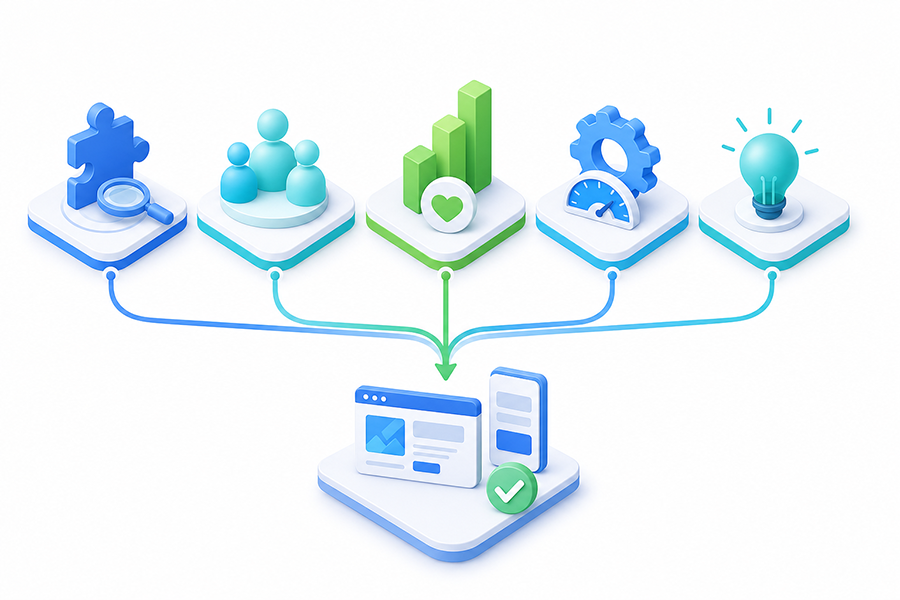
Questions to review before moving forward
- Is the need observable? Use real situations, enquiries or tasks rather than intuition alone.
- Who would use it first? Choose an accessible initial audience for testing.
- What would make it useful? Select a verifiable behavior or outcome.
- What can wait? Separate future improvements from the essential journey.
Problem → Audience → Proposition → Prototype → Test → Learning
An initial event could be outcome_completed. The metric should represent user value rather than activity alone.
How to put it into practice
- Document the hypothesis. Write the problem, audience and expected outcome.
- Design the core journey. Show how a person moves from need to benefit.
- Build a testable version. Include what is required to complete that journey well.
- Observe and adjust. Combine usage data with conversations before expanding.
The initial scope should be small enough to learn and complete enough to earn trust during real use.
A reference for further reading
For a structured approach to hypotheses and experiments, see Strategyzer’s Testing Business Ideas resources.
Conclusion
Building the essential journey first reduces waste and improves the conversation with future users.
An idea starts becoming a product when it stops listing possibilities and proves that it can solve a concrete problem.