

For years, the primary interface of online software was a screen: a person signed in, opened a menu, and clicked buttons. In 2026, another form of interaction is gaining ground. An artificial intelligence agent can interpret a request, consult several sources, and use tools to complete part of a process.
This does not mean graphical interfaces will disappear or that every system needs an agent. It means businesses should begin assessing whether their software is ready to receive actions from users operating through an automated layer.
The change may look small, but it affects architecture, permissions, and accountability. Asking whether AI can connect is no longer enough. The useful question is: what may it read, what may it change, under whose identity, and how will we reconstruct what happened?
From software used by people to software operated by agents
A conventional chatbot answers questions. An agent can select tools and execute steps to accomplish an objective. It could, for example, check an order, verify inventory, prepare a response, and create a task for an employee.
The move toward interoperability became more visible with protocols such as Model Context Protocol. In December 2025, MCP became one of the founding projects of the Linux Foundation's Agentic AI Foundation. This does not guarantee it will be the only technical option, but it shows that connections between agents, data, and tools are moving toward more standardized mechanisms. The Linux Foundation announcement describes this governance change.
Our editorial interpretation is that value will not come from simply adding chat to a system. It will come from turning existing functions into secure, understandable capabilities that can be reused by people, automations, and agents.
Preparing software for agents is not about handing them the system's keys. It is about designing specific doors and deciding who may open each one.
Five capabilities the software should prepare
1. Small, clearly defined tools
A generic function such as manage customers is too broad. It is safer to separate operations: find a customer, retrieve an account status, add a note, or request an update. Each tool should declare its inputs, outputs, possible errors, and whether it changes data.
This separation makes each capability easier to test and classify by risk. OpenAI's practical guide to building agents distinguishes tools that retrieve data from tools that perform actions and recommends stricter controls for sensitive or difficult-to-reverse operations.
2. Identity and minimum permissions
An agent should not automatically inherit every permission associated with an administrator account. The system should identify the user, the agent, the application running it, and the requested resource. Access may also need to be limited by organization, branch, project, record type, or action.
The MCP authorization specification includes principles such as resource-bound tokens, audience validation, and restrictions against indiscriminate token passthrough. Whatever protocol is selected, the general criterion remains useful: one credential should not become a universal pass.
3. Approval before critical actions
Reading inventory and canceling a sale do not carry the same risk. The system should classify its actions and require confirmation when financial, legal, operational, or reputational consequences are possible.
- Low risk: reading authorized information or preparing a draft.
- Medium risk: creating a task, changing reversible data, or sending an internal notification.
- High risk: making payments, deleting records, changing permissions, canceling transactions, or communicating externally on behalf of the business.
An approval should not be an ambiguous message. It should show the proposed action, the affected record, the relevant data, and the foreseeable consequences.
4. Business rules outside the model
Important limits should not depend only on a natural-language instruction. If a refund cannot exceed a threshold, employees cannot access another branch, or a closed order cannot be modified, those conditions must be enforced by the software.
The agent may propose an action. The system must determine whether that action is valid. This separation reduces reliance on probabilistic model behavior and preserves a verifiable source for critical rules.
5. Complete traceability
Every execution should record at least the identities involved, requested tool, relevant parameters, result, approvals, and errors. Where appropriate, the versions of the tool and applied rules should also be recorded.
This does not mean retaining every conversation indefinitely. It means preserving enough evidence to answer operational questions: who initiated the task, why it was authorized, what changed, and how it can be corrected.
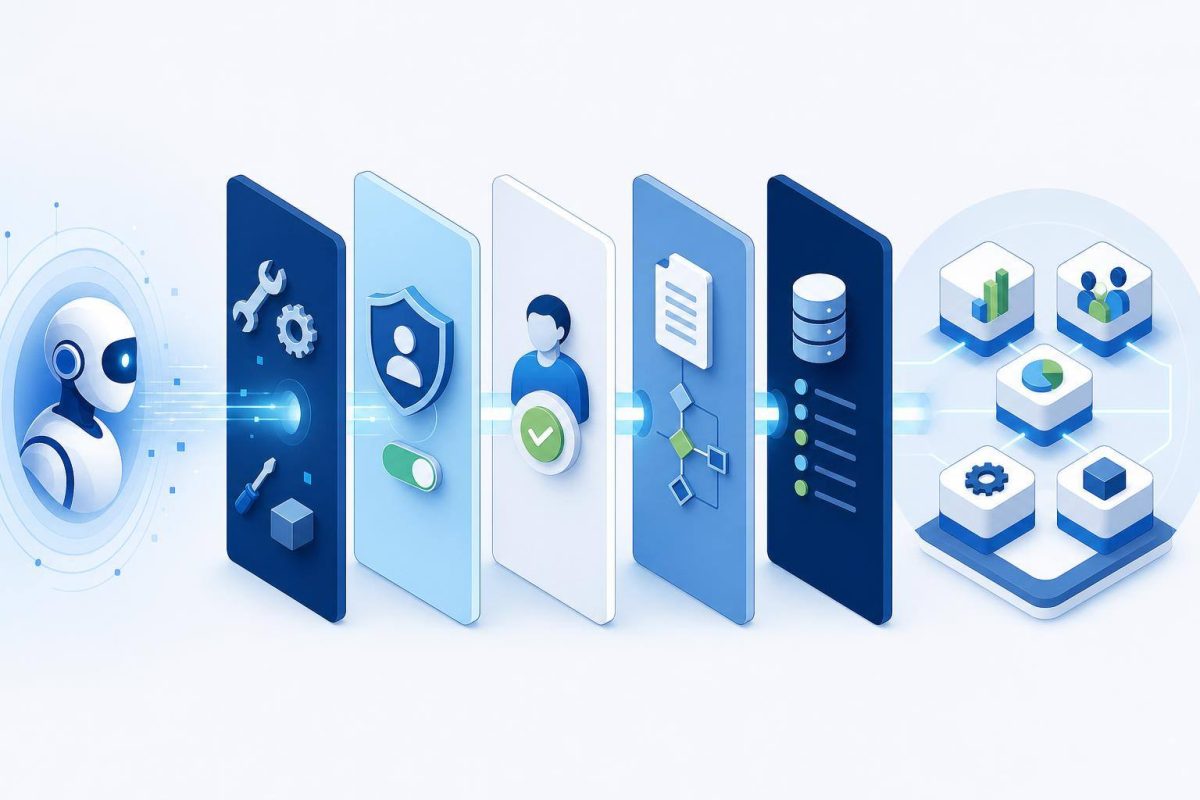
The challenge is not just connection but containment
An agent combines instructions, external data, and the ability to act. This combination creates risks that do not appear in exactly the same way in a conventional integration. An email, document, or webpage could contain malicious instructions intended to redirect the agent. An overly broad tool could turn a misunderstanding into a large-scale modification.
In May 2026, a NIST analysis of AI agent security reported broad agreement among respondents that agents introduce novel threats and that fundamental cybersecurity practices remain necessary but require adaptation.
The OWASP Top 10 for Agentic Applications for 2026 also organizes risks involving autonomy, tools, identity, memory, and interactions among components. The practical conclusion is clear: a standalone content filter cannot replace permissions, validation, isolation, and monitoring.
A roadmap for preparing an existing system
- Select a bounded process. Start with a frequent, measurable, reversible task rather than the entire administration of the business.
- Map data and actions. Separate what the agent must read from what it might modify.
- Create specific tools. Design small functions with structured inputs, validation, and predictable responses.
- Assign risks and permissions. Define scope, limits, approvals, and rejection conditions for every tool.
- Test adversarial cases. Include conflicting instructions, incomplete data, attempts to access unrelated records, and unexpected repetitions.
- Observe before expanding. Measure errors, human interventions, time saved, rejected actions, and required corrections.
During the first phase, it may be safer for the agent to prepare proposals without executing them. It could draft a response, identify records it would update, or create an order pending approval. This validates its behavior without granting full autonomy.
What should be built first
The priority should not be an agent that can do many things. It should be a software foundation that supports additional capabilities without losing control. In practice, the most valuable first components are often:
- a consistent API or service layer;
- a granular permission model;
- centralized business rules;
- searchable audit records;
- approval and reversal mechanisms;
- a testing environment separated from production data.
These improvements do not benefit AI alone. They also support conventional integrations, mobile applications, automations, and maintainability. The investment can therefore retain value even if the agent's provider or model changes.
Conclusion: design gradual autonomy, not unrestricted access
Agents are turning online software into something that can be operated through goals rather than screens alone. However, having the ability to act does not imply authorization to do so.
A practical first step is to select one process, list its available actions, and classify each action by impact. The business can then decide which operations will be read-only, which will generate drafts, and which will require human approval.
If the current system lacks bounded APIs, granular permissions, or adequate records, that foundation should be addressed before increasing autonomy. Ideasweb can help assess and develop custom software and systems prepared to integrate tools and agents with controls suited to real operational needs.