

A return is not automatically a failure. It is a normal part of distance selling. The real problem begins when customers cannot tell whether their situation qualifies, what to do, what it will cost, or when they will hear back.
That is why a return and exchange policy should not be treated only as a commercial condition. It also needs to work as an operating guide for the customer and for the people who support, pick, receive, inspect, and refund orders.
A useful policy does not promise unlimited solutions: it honestly explains what happens, who does each part, and when.
This guide offers a method for creating clear, workable rules. It is not a substitute for legal review: information duties, withdrawal rights, warranties, and refunds vary by country, product, and sales channel. For example, the European Commission outlines specific rights for distance purchases. Always check the rules that apply to your business.
Start by separating the cases your team needs to handle
The word “return” often covers very different situations. When they are all managed under one vague rule, exceptions, contradictory messages, and delays multiply.
Define at least these scenarios separately:
- Change of mind: the item arrived correctly, but the customer no longer wants it.
- Exchange: the customer needs another size, color, variation, or product.
- Damaged, faulty, or incorrect item: the order differs from what was bought or has a problem.
- Incomplete order: an item, accessory, or stated component is missing.
- Delivery issue: the package did not arrive, was delayed, or had a shipping incident.
For every scenario, agree on a concrete response. Saying “returns accepted” is not enough. Define the time limit, item condition, evidence needed when relevant, contact channel, shipping cost, possible outcome, and expected resolution time.
Turn the policy into a decision matrix
Before writing public-facing copy, build an internal table. It helps uncover promises that the operation cannot yet keep.
- Reason: why is the customer requesting a return or exchange?
- Time limit: what starts the clock, and when does the request period end?
- Item condition: must it be unused, with packaging, tags, or accessories?
- Return shipping owner: does the store pay, does the customer pay, or does it depend on the case?
- Outcome: exchange, store credit, repair, refund, or another permitted option?
- Internal owner: who authorizes, receives, checks, and confirms?
- Operational timing: how long do the first response and final resolution take?
The difference between commercial conditions and legal obligations matters. A store can set internal procedures, but it cannot use its policy to remove rights provided by applicable law. As a practical reference, the US Federal Trade Commission advises shoppers to check who pays return shipping, the time limit, and any restocking fees.
Write instructions a customer can follow without asking for help
A detailed policy may be necessary, but customers should not need to interpret vague paragraphs. Use headings, questions, and ordered steps. A person should be able to find an answer from a mobile device.
Minimum information worth publishing
- Which products or situations are covered.
- Which time limits apply and when they begin.
- How to start a request: account area, form, email, messaging, or support channel.
- Which details to send: order number, product, reason, and only when relevant, photos or other evidence.
- How the item is handed over or shipped and who pays in each case.
- What happens after receipt: inspection, approval, explained refusal, exchange, or refund.
- How and when the outcome will be communicated.
- Relevant exceptions, explained precisely and reviewed under applicable rules.
Avoid phrases such as “each case will be assessed” when they do not state criteria or timing. Do not bury important conditions at the bottom of the page. An exception may be appropriate in some contexts, but it needs to be visible before purchase and easy to understand.
Make the information available before, during, and after purchase
Publishing one page in the footer is necessary, but it is often not enough. A customer may look for this information while comparing items, before payment, or only once a problem occurs.
Baymard Institute’s ecommerce research reports that 52% of surveyed online shoppers made at least one return in the preceding 12 months. The editorial takeaway is straightforward: returns should not be treated as exceptional content or hidden until a complaint appears.
Place consistent information at these points:
- on the product page, with a short summary and a link to the full policy;
- in the cart or checkout when a special condition affects the decision;
- in the order-confirmation email;
- in the customer account, with access to the order and request process;
- in the help area and site footer;
- in the support team’s saved replies.
The summary must match the full version. If an item has particular restrictions, do not use generic copy that conflicts with them.
Build the internal process before promising speed
The public policy depends on an internal chain. If the team cannot identify the order, authorize the return, record arrival, inspect the item, and trigger the refund, clear wording will not prevent frustration.
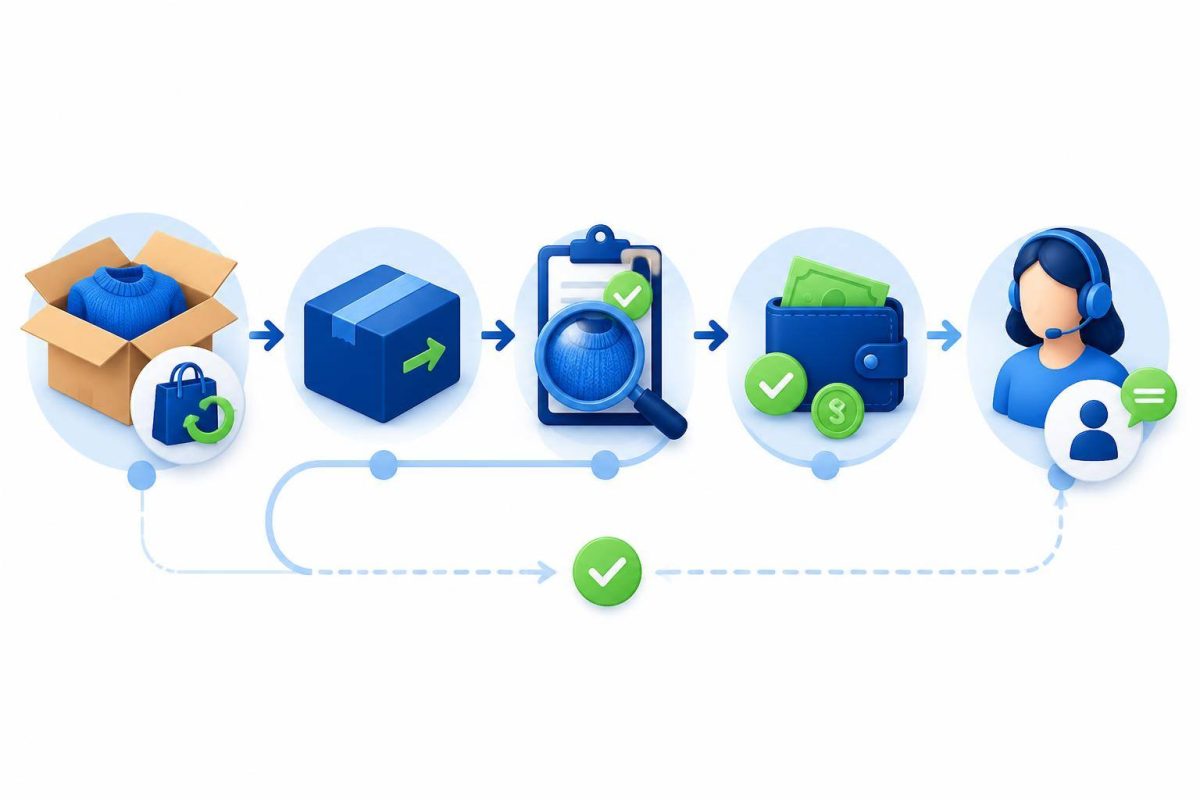
Basic operational flow
- The customer starts the request through a defined channel.
- The team validates the order and classifies the reason.
- Instructions and, where applicable, an authorization or label are sent.
- The item is received and recorded with date, condition, and owner.
- It is checked against previously agreed criteria.
- The relevant exchange, credit, repair, or refund is completed.
- The closure is communicated and the order status is updated.
Track at least four measures: requests by reason, time to first response, time to resolution, and recurring causes by product. If size exchanges, damage, or picking errors recur, the answer may be better size guidance, images, picking controls, or packaging—not a stricter policy.
Review the policy with real-order scenarios
Before publishing, simulate three cases: a variation exchange, a faulty item, and a delivery issue. Ask someone who did not draft the policy to start each process from the website and purchase email.
Revise it if that person cannot quickly answer: “Can I request this?”, “What do I do now?”, “What will it cost?”, “What proof do I need?”, and “When will I know the outcome?” Then confirm that support, logistics, and administration use the same version of the rules.
Conclusion: clarity before purchase, traceability afterward
A strong return and exchange policy is not about accepting everything or rejecting everything. It is about defining cases, communicating material conditions at the right time, and maintaining a process the team can deliver.
If your business needs to bring catalog, orders, statuses, and support information into one coherent experience, explore our online store service. The starting point is translating real operations into a simple journey for customers and the team.