

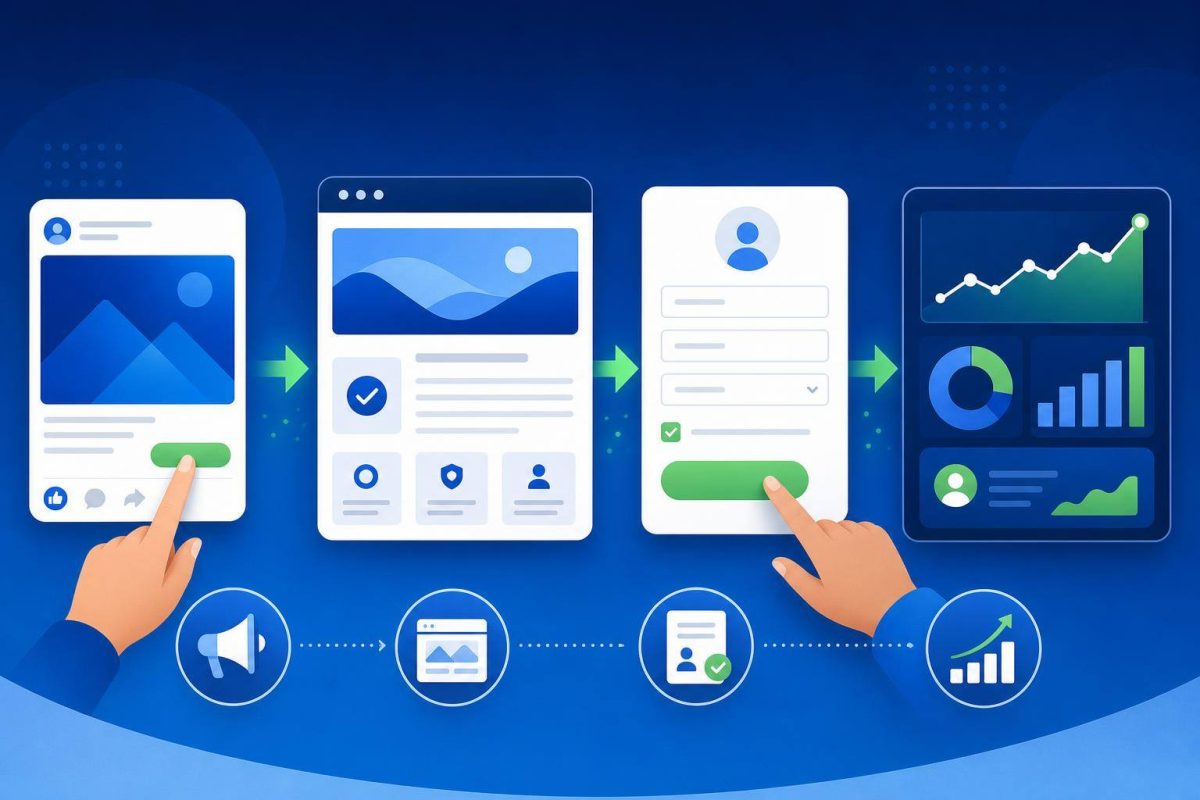
Getting clicks is not the final objective of a campaign. After the ad comes a second decisive moment: the page receiving the visitor must help that person understand the offer, trust it, and complete an action.
When an ad leads to a website's general homepage, visitors have to find the promised information themselves. A landing page prevents that detour by focusing the message on one offer, one audience, and one primary action.
A strong landing page does not pressure visitors; it removes the doubts preventing them from moving forward.
What a landing page is supposed to do
A landing page is the page someone reaches after clicking an advertisement, email, social post, or another campaign link. It does not necessarily have to be an isolated page, but it should respond directly to the context that generated the visit.
Google Ads' landing page documentation explains that landing page experience depends on factors such as the usefulness and relevance of the information, ease of navigation, and whether the page meets the expectations created by the advertisement.
In practical terms, the landing page should quickly answer these questions:
- Am I in the right place? The headline should continue the promise made in the ad.
- What is being offered? The proposition must be specific and understandable.
- Is it suitable for me? The page should identify whom it helps and under what circumstances.
- Why should I trust it? It needs verifiable evidence and clear conditions.
- What should I do next? The primary action must be visible and concrete.
Start with the action you want to generate
Designing the page first and deciding what to measure later often results in generic forms and ambiguous calls to action. Start instead with an action connected to the real sales process.
Depending on the business, this action might be:
- requesting a quote;
- booking a call or demonstration;
- checking availability;
- starting a sales conversation;
- registering for an activity;
- downloading a resource when a follow-up strategy is in place.
The selected action should represent meaningful progress, not merely an interaction that is easy to count. A download may be useful, for example, but it is not automatically equivalent to a qualified business opportunity.
Google Analytics uses the term key event for an action that is particularly important to business success. Its documentation explains how key events can help evaluate the channels contributing to those actions and can be used to create conversions in Google Ads. See the official guide to Google Analytics key events.
Connect the advertisement to the page content
Continuity between an advertisement and its landing page is often called message match. If an ad promotes an initial assessment, a particular service category, or a specific condition, that same proposition should appear at the beginning of the page.
Compare both elements before publishing:
- Intent: the page must address the need that triggered the advertisement.
- Promise: do not expand, hide, or change the offer after the click.
- Terminology: use words the audience recognizes without mechanically repeating every keyword.
- Action: the calls to action in the ad and on the page should lead to the same next step.
- Audience segment: if two audiences have different problems or decision criteria, separate pages may be more appropriate.
This does not mean turning the advertisement into a longer piece of copy. The page must develop its promise by explaining the scope, addressing objections, and providing the information needed to decide.
Build a page that is concise but sufficient
There is no universal ideal length. A simple, low-commitment action may need little explanation, while a complex service or a decision with higher perceived risk needs more context. The editorial rule is to include what people need for the next step without filling the page with irrelevant information.
A useful structure
- Opening section: a concrete proposition and call to action.
- Problem or need: a brief description of the visitor's situation.
- Solution: what is offered and what it includes.
- Benefits: advantages expressed without claims that cannot be demonstrated.
- Process: what happens after the visitor submits an inquiry.
- Evidence: cases, authorized testimonials, experience, methodology, or verifiable company information.
- Frequently asked questions: answers to important objections.
- Final form or action: a clear repetition of the next step.
Keep one primary action. It can appear in several places, but buttons leading toward incompatible objectives divide attention. Secondary links should exist only when they help someone decide, such as links to important conditions or essential company information.
Reduce friction in the form and the website
Every field requires time, attention, and trust. Asking for information that will not yet be used may reduce people's willingness to complete a form. The W3C Web Accessibility Initiative forms tutorial recommends requesting only necessary information and providing understandable labels, instructions, and error feedback.
A practical review should confirm:
- that every field has a clear, visible label;
- that required information is identifiable;
- that error messages explain how to correct the entry;
- that the form can be completed with a keyboard;
- that the button describes the action, such as “Request an assessment,” instead of using a generic “Submit”;
- that users receive confirmation after sending the form;
- that the responsible team actually receives and processes the inquiry.
Friction can also occur before the form. A slow, unstable, or difficult mobile page can interrupt the journey. Google describes Core Web Vitals as metrics covering loading, responsiveness, and visual stability. Its current reference values are LCP within 2.5 seconds, INP below 200 milliseconds, and CLS below 0.1, assessed using real-world experience. Details are available in the Google Search Central Core Web Vitals documentation.
These values are technical diagnostic references, not a guarantee of sales. A fast page can still fail if its proposition is unclear, while an attractive offer will also lose opportunities if technical problems make the page difficult to use.
Measure opportunities, not only form submissions
The landing page conversion rate is useful, but it does not tell the whole story. A campaign may produce many submissions and very few suitable inquiries. Marketing data should therefore connect with sales follow-up.
At a minimum, record:
- page visits by campaign and source;
- completed primary actions;
- form errors or abandonment when the implementation supports it;
- valid and discarded inquiries;
- sales opportunities created;
- confirmed sales or outcomes when the sales cycle permits responsible attribution.
Before launch, test the entire action on different devices. Verify message delivery, the confirmation page, analytics registration, and the internal response process. A conversion that is measured but not handled is still a lost opportunity.
What to test first
When traffic is sufficient for a meaningful comparison, prioritize hypotheses connected to important decisions:
- a more specific primary proposition;
- a less ambiguous call to action;
- fewer form fields;
- evidence positioned closer to the action;
- a different landing page for each relevant intent.
Do not change every element simultaneously if you need to learn what produced the result. Document the hypothesis, test period, primary metric, and any possible effect on lead quality.
Conclusion: prepare the landing page before buying traffic
An effective landing page brings together five components: audience intent, the advertisement's promise, sufficient explanation, a simple action, and measurement connected to the business. If one component fails, increasing the budget may amplify the problem rather than solve it.
Your next step is to select one campaign and review its page in this order: promise, proposition, evidence, action, mobile operation, measurement, and sales follow-up. Correct obvious obstacles first and only then evaluate variations.
Do you need to coordinate campaigns, landing pages, and measurement? Ideasweb's digital marketing and advertising service can address the complete journey, from strategy and advertisements to evaluating the opportunities generated.